


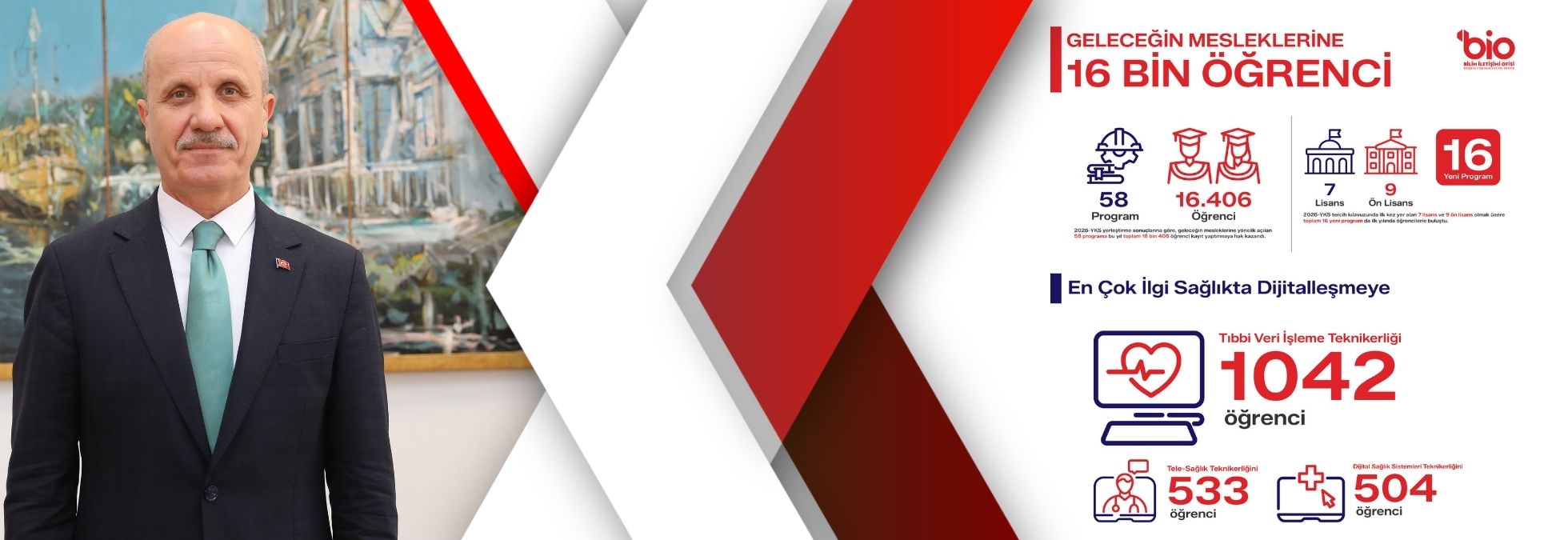
16,000 Students Choose Future Careers
- A total of 16,406 students qualified for admission to 58 employment-oriented programs launched by CoHE over the past three years
- AI-focused programs enrolling students for the first time this year attracted candidates ranked among the top 100, 500, and 1,000
- Careers of the future shape students’ choices
- Programs in digital health and agriculture, data, and green skills draw strong interest
- CoHE President Özvar: “Our young people are closely following the transformation taking place around the world”
“We are turning our universities into dynamic institutions capable of responding to the needs of the future”
August 21, 2026
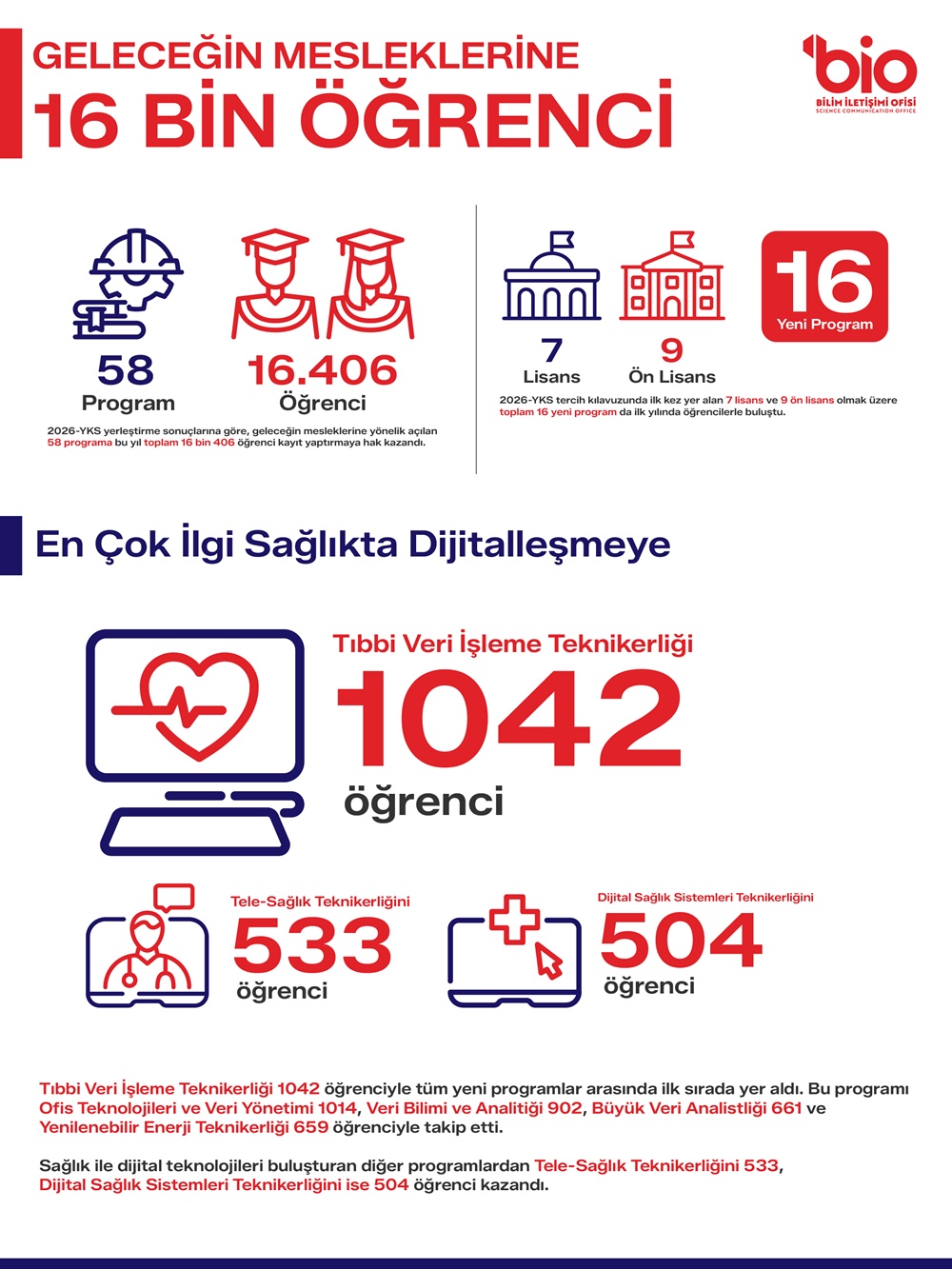
Programs launched by the Council of Higher Education (CoHE) over the past three years as part of its employment-oriented higher education vision have attracted strong interest from students. According to the 2026-YKS placement results, a total of 16,406 students qualified for admission to 58 programs established to prepare students for the careers of the future.
Students’ choices of programs spanning artificial intelligence and data science, digital agriculture and healthcare, green skills, and sustainability demonstrated the growing interest among young people in the careers of the future.
A total of 16 new programs—seven undergraduate and nine associate degree programs—listed in the 2026-YKS preference guide for the first time also welcomed students in their inaugural year. The fact that newly introduced interdisciplinary AI-focused programs were chosen by students ranked among the top 100, 500, and 1,000 drew particular attention.
- “Business Administration and Artificial Intelligence” attracts students from the top 100
The interdisciplinary AI programs listed in the 2026-YKS preference guide for the first time were also chosen by students with outstanding rankings. Ten students ranked among the top 1,000 qualified for the Business Administration and Artificial Intelligence program. Seven of these students ranked among the top 500, while one was among the top 100. Three students ranked among the top 1,000 qualified for the Philosophy and Artificial Intelligence program, two of whom were among the top 500. One student ranked among the top 1,000 also qualified for the History and Artificial Intelligence program in its first year.
CoHE continues to update higher education programs in line with changes in the labor market and technological transformation. As part of these efforts, the undergraduate programs in History and Artificial Intelligence, Philosophy and Artificial Intelligence, Business Administration and Artificial Intelligence, Financial Technology, Biotechnology and Genetics, Paramedic Studies, and Fisheries Technology were added to the 2026-YKS preference guide.
At the associate degree level, the programs in AI-Assisted Web Design and Coding, AI-Assisted Design and Animation, Digital Game Technologies, Mobile Security Technologies, Pharmaceutical Manufacturing Technology, Explosives and Energetic Materials Technology, Livestock Technologies and Management, Laboratory Animals, and Fisheries Technology enrolled students for the first time.
- Digitalization in healthcare draws the most interest
A total of 16,406 candidates qualified for admission to the 58 programs launched over the past three years for which 2026-YKS placement data are available. Programs combining healthcare and digital technologies attracted the strongest interest.
Medical Data Processing Technician Training ranked first among all new programs, with 1,042 students. It was followed by Office Technologies and Data Management with 1,014 students, Data Science and Analytics with 902, Big Data Analytics with 661, and Renewable Energy Technician Training with 659.
Among other programs combining healthcare and digital technologies, 533 students qualified for Telehealth Technician Training, while 504 qualified for Digital Health Systems Technician Training.
902 students qualified for the Data Science and Analytics program, while 661 qualified for Big Data Analytics and 496 for Artificial Intelligence and Machine Learning. Front-End Software Development was chosen by 444 students, Back-End Software Development by 437, and Software Development by 433. A total of 353 students qualified for Corporate Information Technology Specialist, 320 for Information Security Technology, 312 for Information Systems and Technologies, and 266 for Cloud Computing Operations.
Energy and sustainability-focused programs were also among students’ choices. 659 students qualified for Renewable Energy Technician Training, 630 for Electrical Energy Generation, Transmission and Distribution, 301 for Water and Waste Management Technician Training, 272 for Green and Ecological Building Technician Training, and 249 for Environmental Measurement and Monitoring Systems Technician Training.
The Alternative Energy Resources Technology program was chosen by 195 students, while 177 chose Carbon Management Technician Training and 138 chose Hydrogen and Energy Storage Technician Training.
Özvar: “We are seeing the impact of this transformation in our students’ choices”
CoHE President Erol Özvar said the strong interest in programs launched for the careers of the future as part of the transformation underway in higher education is reflected in students’ choices.
Özvar said that through programs in areas such as artificial intelligence, data science, digital agriculture, digital health, energy, and sustainability, they are prioritizing the human resources needs of both today and the future, while also strengthening higher education’s capacity to respond to changing needs.
Expressing his satisfaction at seeing such a strong response to this transformation in candidates’ choices, Özvar said, “The fact that programs designed for the careers of the future are being chosen from their very first years by students with outstanding rankings shows that our young people are closely following technological and economic transformation around the world.”
Özvar said they would continue the transformation of higher education in line with Türkiye’s needs, adding, “Our goal is to turn our universities into dynamic institutions capable of responding not only to today’s needs but also to those of the future. We will continue developing new programs in line with the needs of the labor market, technological advances, and our country’s strategic priorities.”
Images

Images