



Data Analysis School Under the Auspices of CoHE: Applications Open for Free Education Program
August 22, 2025
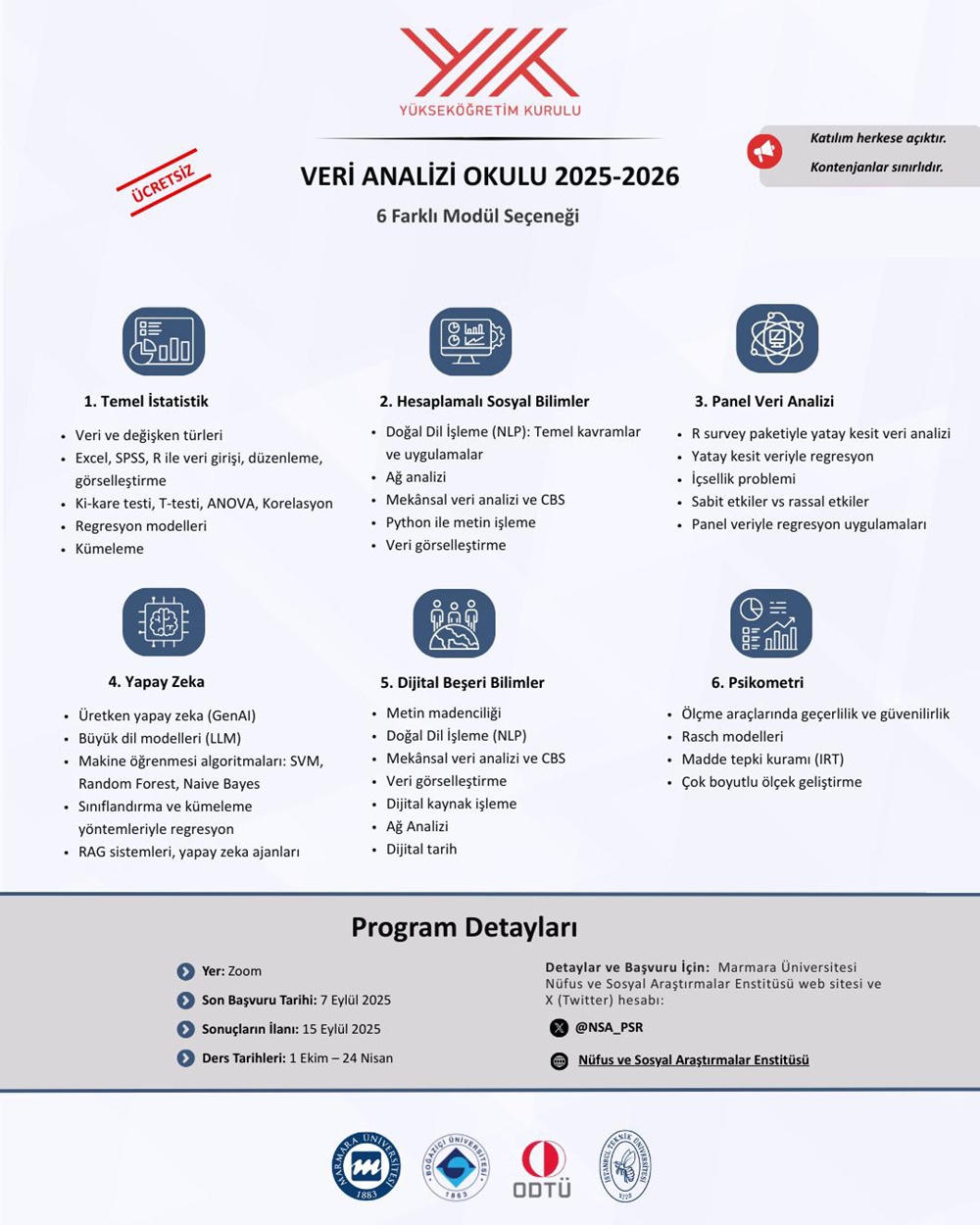
The Data Analysis School, launched under the auspices of the Council of Higher Education (CoHE), is coordinated by Marmara University's Institute of Population and Social Research, with contributions from Türkiye's leading research universities: Middle East Technical University (METU), Istanbul Technical University (ITU), and Boğaziçi University.
Renowned professors from Türkiye's elite universities will provide free “Artificial Intelligence” courses open to everyone.
The Data Analysis School aims to contribute to Türkiye's scientific productivity and accelerate the flow of information between academia, the public sector, and the private sector by combining theoretical knowledge with practical skills in the fields of data analysis, statistics, and artificial intelligence.
The Data Analysis School, which will make a significant contribution to the training of qualified human resources and the development of the research ecosystem, will also pave the way for innovative solutions that will increase Türkiye's global competitiveness.
-Six-Module Training Contents-
The Data Analysis School will begin on October 1, 2025, and run until April 24, 2026. The training will be conducted online and will consist of six separate modules: Basic Statistics, Panel Data Analysis, Psychometrics, Computational Social Sciences, Digital Humanities, and Artificial Intelligence.
The Basic Statistics Module will provide statistical literacy skills that form the basis of scientific thinking and research design. Competencies in data-driven thinking, graphical representation, and analytical interpretation will be developed.
The Panel Data Analysis Module aims to understand and apply complex models involving time and individual effects. Participants will gain the ability to build and interpret panel data models using the R programming language.
The Psychometrics Module will cover the scientific reliability and validity of psychological and social measurement tools. Applied measurement analysis will be conducted using contemporary models such as Rasch and Item Response Theory (IRT).
The Computational Social Sciences Module will teach how to structure data-driven social research using techniques such as Natural Language Processing (NLP), network analysis, and spatial analysis. Applied analysis will be conducted using Python.
The Digital Humanities Module will equip participants with numerical analysis and interpretation skills in the humanities, including history, literature, philosophy, art history, and linguistics, using digital archives, text mining, data visualization, and digital mapping methods.
The Artificial Intelligence Module will involve artificial intelligence-supported analysis applications using social data through supervised and unsupervised learning models, generative artificial intelligence tools, and Large Language Models (LLM).
The training modules, prepared by expert academics in their fields, are based on a curriculum that combines theoretical foundations with practical analysis. Thus, participants will not only gain knowledge but will also be able to effectively use this knowledge in analytical thinking, problem-solving, and innovative application development processes.
-No prerequisites for application-
The program, which is completely free to attend and has no prerequisites for application, will be open to participants from different disciplines and professional fields.
Undergraduate, graduate, and doctoral students, academics, independent researchers, experts and analysts working with data in public institutions, professionals working in civil society organizations and the private sector, those working with data or seeking to develop themselves in this field, and all interested parties aiming to develop analysis-based approaches in decision-making processes can apply to the Data Analysis School.
-Application Process and Evaluation-
Applications will be made online by filling out the online application form available on the official website of the Institute of Population and Social Research at Marmara University and on its social media accounts until September 7, 2025.
The website and social media accounts of the Institute of Population and Social Research at Marmara University are as follows:
X: @NSA_PSR, Instagram: @nsa_psr, Linkedin: Nüfus ve Sosyal Araştırmalar Enstitüsü (NSA_PSR), Website: https://nsa.marmara.edu.tr/
In the evaluation, candidates' academic qualifications, grade point averages, English reading comprehension levels, and the motivation statement included in the application form will be taken into consideration, and the application results will be announced on September 15, 2025.
Images



Images