


Council of Higher Education Continues to Support Employment of Researchers Conducting Scientific Studies at Universities
January 23, 2026
The Council of Higher Education continues its efforts to bring highly qualified PhD researchers into Turkish universities.
Within this scope, Supplementary Article 46 of the Higher Education Law enables highly qualified researchers who hold doctoral degrees from Türkiye or abroad to be appointed part-time at universities. This regulation aims to integrate highly qualified PhD holders into the higher education system and to strengthen universities’ academic and research capacities.
In parallel, under Supplementary Article 34 of the Higher Education Law, PhD researchers are also employed in R&D and design projects. Through this framework, the active involvement of highly qualified human resources in research, development, and innovation activities is supported, thereby reinforcing project-based production in the higher education system.
In line with the “Century of Türkiye” vision, the Council of Higher Education continues to produce concrete outcomes through its efforts focused on the goals of “quality, productivity, and excellence,” “research and innovation,” “internationalization,” and “accessibility and inclusiveness,” in order to enhance and sustain the global and regional competitiveness of the Turkish higher education system.
Supplementary Article 46: Part-Time Academic Contribution from International Universities
Under Supplementary Article 46, implemented in line with the strategic goals of the Council of Higher Education, Turkish and foreign PhD researchers working at international universities, R&D centers, public institutions, or private sector laboratories are able to serve at Turkish universities. Researchers appointed within this scope can teach in undergraduate and graduate programs, supervise students, take part in scientific projects, and produce scientific publications and outputs.
Supplementary Article 34: Postdoctoral Researchers in R&D and Design Projects
Under Supplementary Article 34, contracted PhD researchers can be employed in R&D and design projects at state universities. With this practice, which is open to researchers who have not exceeded seven years after completing their doctorate, the aim is to maintain the connection of PhD holders who are not employed outside academia with higher education and to include them in scientific production.
Both practices, implemented by the Council of Higher Education to keep the research ecosystem vibrant, dynamic, and sustainable and to protect and develop qualified human resources at universities, continue to attract strong interest from the scientific community.
114 Researchers Served at Turkish Universities in 2025 Under Supplementary Article 46
Throughout 2025, under Supplementary Article 46, applications from 114 researchers from leading universities and institutions such as the University of Turin, Microsoft Research (USA), Newcastle University, Duke University, South China Normal University, the University of Tokyo, the University of Oxford, the University of Giessen, the College of Dental Medicine – Qatar University, and Politehnica University of Bucharest were approved, and these researchers were appointed to Turkish universities.
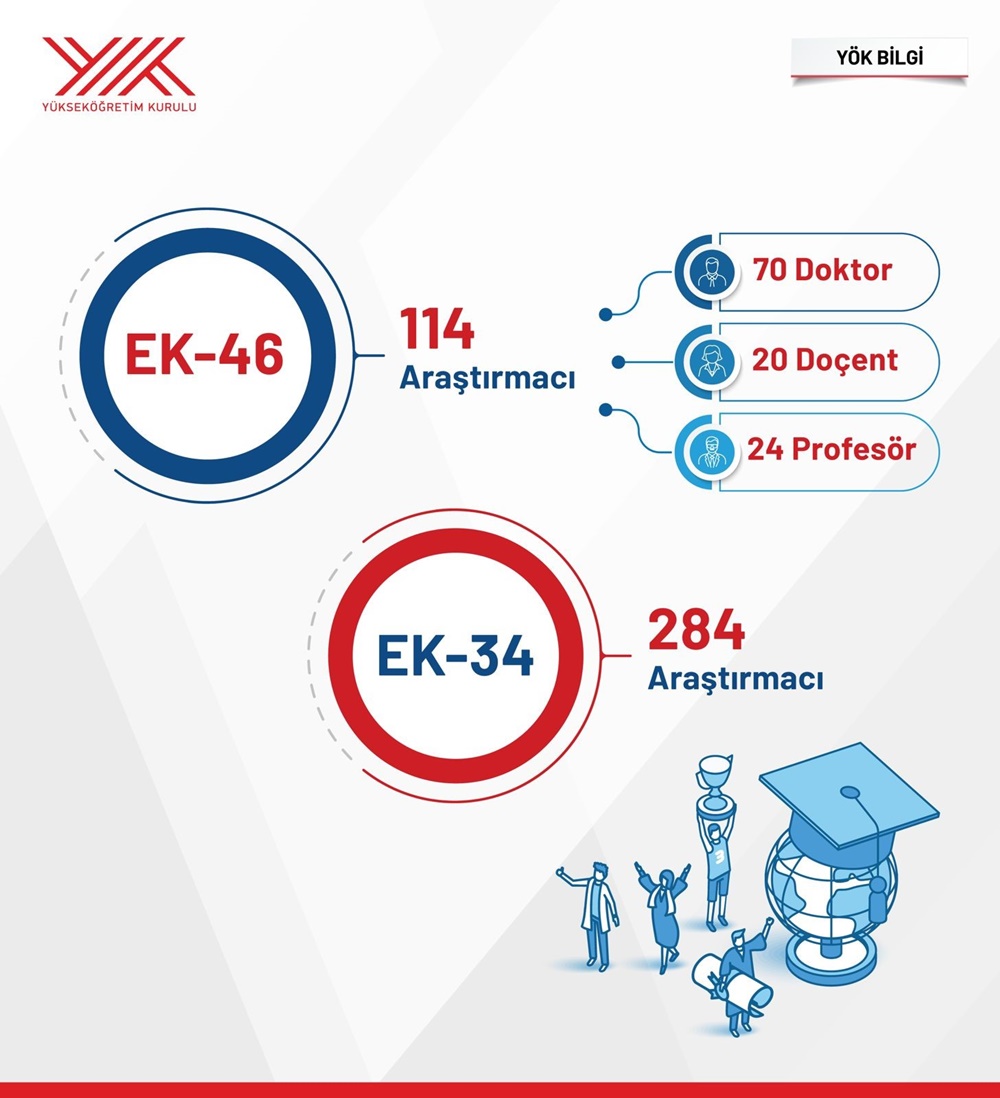
Of the total 114 researchers, 70 were appointed from 38 institutions in Türkiye. Under Supplementary Article 46, 70 PhD holders, 20 associate professors, and 24 professors served in academia last year.
Chemistry, Biology, and Physics Stand Out Under Article 34; Engineering Under Article 46
Under Supplementary Article 34, a total of 284 researchers were approved for employment at higher education institutions in 2025. While 187 of them applied to the program for the first time, the terms of 97 researchers were extended, enabling them to continue their scientific activities.
Under Supplementary Article 46, the highest number of applications came from the field of engineering. Other preferred fields included basic sciences (physics, chemistry, biology, mathematics), health sciences, social sciences, life sciences, and educational sciences.
The universities receiving the highest number of applications and appointing the most researchers are İhsan Doğramacı Bilkent University, Biruni University, Gebze Technical University, Middle East Technical University, Zonguldak Bülent Ecevit University, Istanbul Technical University, Atılım University, Bursa Technical University, and Ege University.
Under Supplementary Article 34, the universities with the highest number of approved appointment requests in 2025 are Bursa Uludağ University, Çukurova University, Hacettepe University, Middle East Technical University, Süleyman Demirel University, Dokuz Eylül University, Ege University, Erciyes University, Bolu Abant İzzet Baysal University, and Marmara University.
The 284 researchers employed under this program were most active in basic sciences (physics, chemistry, biology, and mathematics), as well as in engineering, health sciences, social sciences, life sciences, and educational sciences.
Thus, in 2025, a total of 114 researchers holding the titles of professor, associate professor, and PhD from 44 institutions abroad and 38 institutions in Türkiye were appointed to Turkish universities under Supplementary Article 46. Under Supplementary Article 34, a total of 284 postdoctoral researchers were employed in R&D and design projects at many universities over the past year.
Özvar: “Practices That Strongly Serve Our Internationalization Goals”
President of the Council of Higher Education, Erol Özvar, stated that especially through appointments under Supplementary Article 46, they aim to strengthen both students’ and faculty members’ ties with industry through highly qualified PhD researchers working in the sector.
Özvar said: “We wish for our universities to engage more with high-quality national and international researchers in both the public and private sectors, both at home and abroad, and to benefit more from these opportunities. These practices, which strongly serve our internationalization goals, represent a turning point for our higher education system in terms of university–industry cooperation.”
Images
Images