


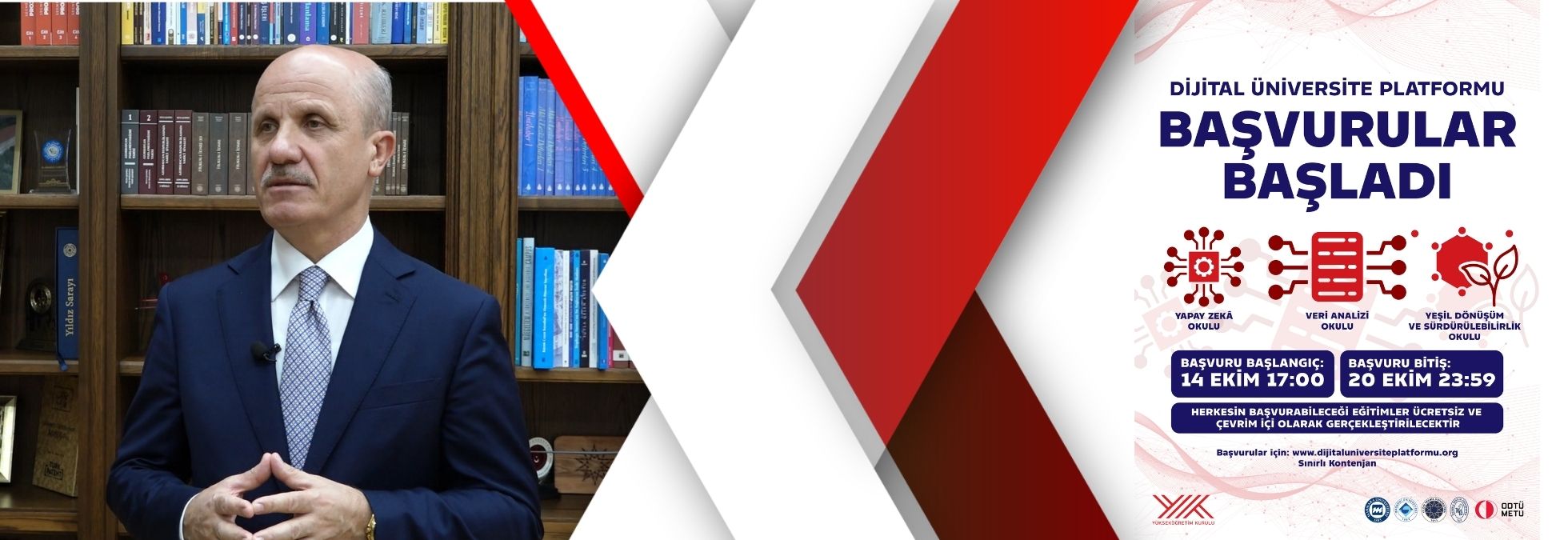
Applications Open for Digital University Platform
- Free training will be offered through 16 modules in artificial intelligence, data analytics, and the green transition
- CoHE President Özvar: “The Digital University Platform will play a vital role in equipping young people with the skills needed for the professions of the future.”
- “These three schools will provide new opportunities and strengthen Türkiye’s capabilities in digital technologies and artificial intelligence.”
October 14, 2026
Applications have opened for the Digital University Platform, launched under the auspices of the Council of Higher Education (CoHE). The platform will offer free, open-access training in artificial intelligence, data analytics, and sustainability, delivered by internationally recognized academics from some of Türkiye’s leading universities.
The platform comprises three schools—Artificial Intelligence, Data Analytics, and Green Transition and Sustainability—and offers a total of 16 course modules. Courses will be taught by academics from Boğaziçi University, Middle East Technical University (METU), Istanbul Technical University (ITU), Marmara University, and Yıldız Technical University. Applications can be submitted via www.dijitaluniversiteplatformu.org until 11:59 p.m. on October 20. Application results will be announced on October 30, 2026, and communicated to applicants by email. Courses will begin on November 3, 2026.
CoHE President Erol Özvar stated that the Digital University Platform had been launched to develop Türkiye’s qualified human resources and prepare young people for the professions of the future.
Emphasizing that one of CoHE’s most important responsibilities was to diversify, enrich, and deepen the country’s talent pool, Özvar said: “The Digital University Platform will play a vital role in equipping young people with the skills needed for the professions of the future.”
Özvar noted that the 16 course modules offered through the three schools would help develop the competencies needed, particularly in digital technologies and artificial intelligence. “I believe these modules and the three schools under which they are offered will create new opportunities and add new strength to the digital and artificial intelligence talent that our country needs today,” he said.
More Than 135,000 Applications Received Last Year
Özvar recalled that the foundations of the Digital University Platform had been laid by the Artificial Intelligence and Data Analytics School program launched last year. He said the strong interest in online training had been a decisive factor in expanding the initiative.
More than 135,000 people applied to the Artificial Intelligence and Data Analytics School last year, while over 30,000 participants continued their training throughout the two terms. Özvar noted that this level of interest had clearly demonstrated the need for a digital university.
He added that Yıldız Technical University had joined this year’s program, which had previously been delivered with contributions from four universities, allowing the courses to be offered with a broader curriculum.
“Do Not Delay Your Application”
Özvar stated that digitalization not only equips people with new professional skills but also gives them opportunities to keep up with developments around the world. He noted that the platform would help participants become familiar with evolving technologies and emerging needs.
Highlighting the platform’s inclusive, accessible, and free nature, Özvar called on members of the public interested in taking courses to apply. “I encourage everyone wishing to take these courses not to delay their applications to the Digital University Platform,” he said.
Inclusive, Accessible, and Free
The platform will be implemented under the coordination of Marmara University’s Institute of Population and Social Research and Yıldız Technical University. Boğaziçi University, Istanbul Technical University, and Middle East Technical University will also contribute academically to the program.
The Digital University Platform brings together the Artificial Intelligence School, the Data Analytics School, and the Green Transition and Sustainability School.
The Artificial Intelligence School will offer three modules: “Machine Learning,” “Enabling Tools,” and “Modern Software Development.”
The Data Analytics School will offer seven modules: “Fundamental Statistics,” “Panel Data,” “Computational Social Sciences,” “Digital Humanities,” “Psychometrics,” “Biostatistics,” and “Data Analytics.”
The Green Transition and Sustainability School will offer six modules: “Climate Change and Global Policies,” “Corporate Sustainability,” “Environmental Sustainability,” “Circular Economy and Sustainable Finance Ecosystem,” “Social Sustainability,” and “Clean Energy Technologies.”
Applicants may apply for up to two modules, including modules from different schools, provided that their class schedules do not overlap.
Classes Do Not Overlap for 114 of the 120 Possible Module Combinations
The course schedule has been designed to allow participants to take two different modules simultaneously. Of the 120 possible pairs formed by the 16 modules, 114 can be taken together without schedule conflicts.
There will be no separate enrollment quota for individual modules. If the number of applications is high, applicants will be assessed according to the criteria relevant to the module concerned.
The program will run over two terms and last approximately 24 weeks. There will be a break between January 23 and February 28, 2027, and training will conclude on June 4, 2027. Start and end dates will vary by module according to course content.
Depending on the modules selected, each participant’s total course load will range from 14 to 24 sessions, equivalent to 42 to 72 class hours. The Machine Learning module in the Artificial Intelligence School will comprise 24 sessions and 72 class hours; Fundamental Statistics will comprise 22 sessions and 66 class hours; and Social Sustainability will comprise 14 sessions and 42 class hours.
Images


Images