


Council of Higher Education Reshapes Higher Education in Line with Future Professions
- Higher education embraces the future: 16 new academic programs to be launched
- AI-based programs, digital gaming, mobile security, and pharmaceutical manufacturing stand out among the new programs
- Artificial intelligence is no longer just for engineers: History and philosophy also meet AI
- President of the Council of Higher Education Erol Özvar: “We are transforming our higher education system by taking into account not only today’s workforce needs, but also those of the future.”
- The Council of Higher Education and universities take to the field to promote the professions of the future
July 1, 2026
The Council of Higher Education is restructuring higher education in line with the professions of the future.
Türkiye’s higher education system is undergoing a major transformation driven by the country’s development goals, the future needs of the labor market, digital transformation, artificial intelligence, and the demands of strategic sectors.
Fields that Türkiye will need in the future are now being transformed into new academic programs at universities. For the 2026–2027 academic year, the Council of Higher Education is introducing a total of 16 new academic programs for the first time, including 7 undergraduate and 9 associate degree programs.
The new programs, spanning artificial intelligence, financial technologies, biotechnology, mobile security, digital game technologies, and pharmaceutical manufacturing, will be included in the 2026 Higher Education Institutions Examination (YKS) Preference Guide.
- History and philosophy meet AI
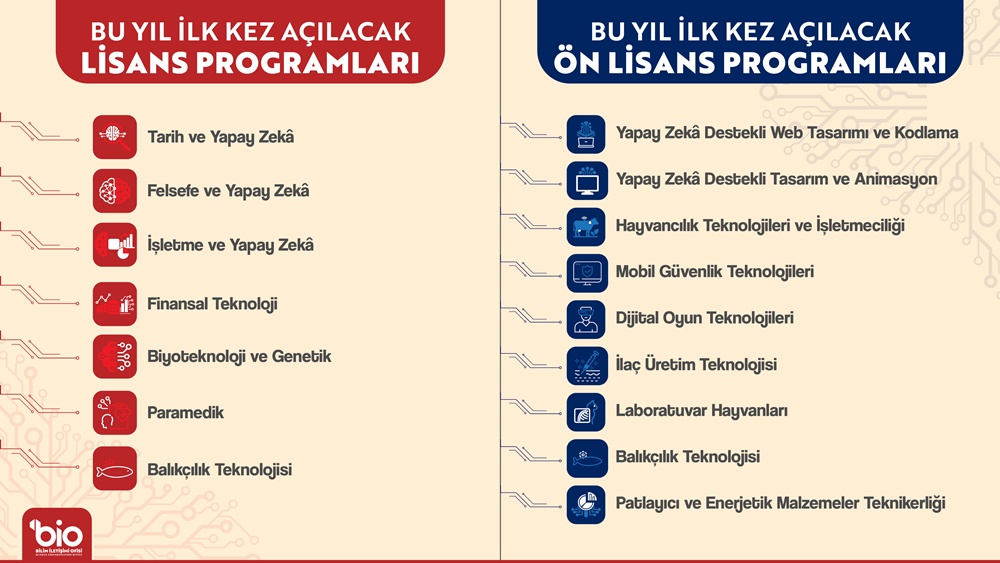
Among the newly introduced programs this year, History and AI, Philosophy and AI, and Business Administration and AI stand out.
Designed to extend artificial intelligence beyond engineering and computer science into the social sciences, these programs represent some of the latest examples of the interdisciplinary approach to higher education.
In addition to these three programs, undergraduate programs in Financial Technology, Biotechnology and Genetics, Paramedicine, and Fisheries Technology will also admit students for the first time this year.
At the associate degree level, the following programs will appear in the preference guide for the first time: AI-Assisted Web Design and Coding, AI-Assisted Design and Animation, Digital Game Technologies, Mobile Security Technologies, Pharmaceutical Manufacturing Technology, Explosives and Energetic Materials Technology, Livestock Technologies and Management, Laboratory Animals, Fisheries Technology.
- Universities’ program portfolio is evolving
In recent years, numerous new academic programs have been incorporated into the higher education system in strategic fields, particularly artificial intelligence, data science, cybersecurity, digital health, green transformation, and advanced manufacturing technologies.
As part of this transformation, the Council of Higher Education previously introduced nearly 70 new academic programs, including: 8 undergraduate and 13 associate degree programs focused on artificial intelligence, 2 undergraduate and 4 associate degree programs focused on digitalization in agriculture, 4 associate degree programs focused on digitalization in healthcare, 1 undergraduate and 8 associate degree programs focused on the green transition, and 27 associate degree programs developed in response to industry needs.
With the programs introduced this year, the transformation of higher education toward digitalization, high technology, and strategic production is being advanced even further.
- “We are planning our quotas according to the needs of the future”
President of the Council of Higher Education Erol Özvar stated that the new programs were designed by taking into account not only today's workforce demands but also those of the future.
Emphasizing that program planning has been carried out in line with Türkiye’s development goals, Özvar said:
“We have revised our program quotas by considering a wide range of parameters, including Türkiye’s employment planning, workforce needs, emerging fields of the future, and the effective development of our country's human capital. We have created new quotas by introducing new programs, particularly those focused on artificial intelligence and digital technologies.”
- “We will no longer insist on programs that do not generate employment”
Highlighting that the transformation process in higher education will continue with determination, Özvar stressed that programs that have fallen behind the times should be reassessed.
He stated: “We do not believe it is appropriate to continue insisting on programs that are no longer aligned with today’s conditions, that offer no meaningful opportunities for their graduates, and that have lost their connection with both employment and academic productivity. We will continue the transformation process with the same determination.”
- “Universities must align with the skills of the future”
Emphasizing that the planning of new academic programs has been shaped by industry expectations and technological developments, Özvar noted:
“Transformation is accelerating across every field in today’s world. Anticipating the skills of the future, keeping pace with industry expectations and technological developments, and taking into account our country’s development priorities are of critical importance. We expect our universities to prepare proposals for new programs and student quotas with this vision in mind. This approach is vital both for the efficient use of national resources and for enhancing the employability of our graduates.”
- The Council of Higher Education and universities take action
To strengthen public engagement with its transformation initiatives focused on the professions of the future, the Council of Higher Education is involving the Science Communication Offices established at universities in this process.
Images




Images