


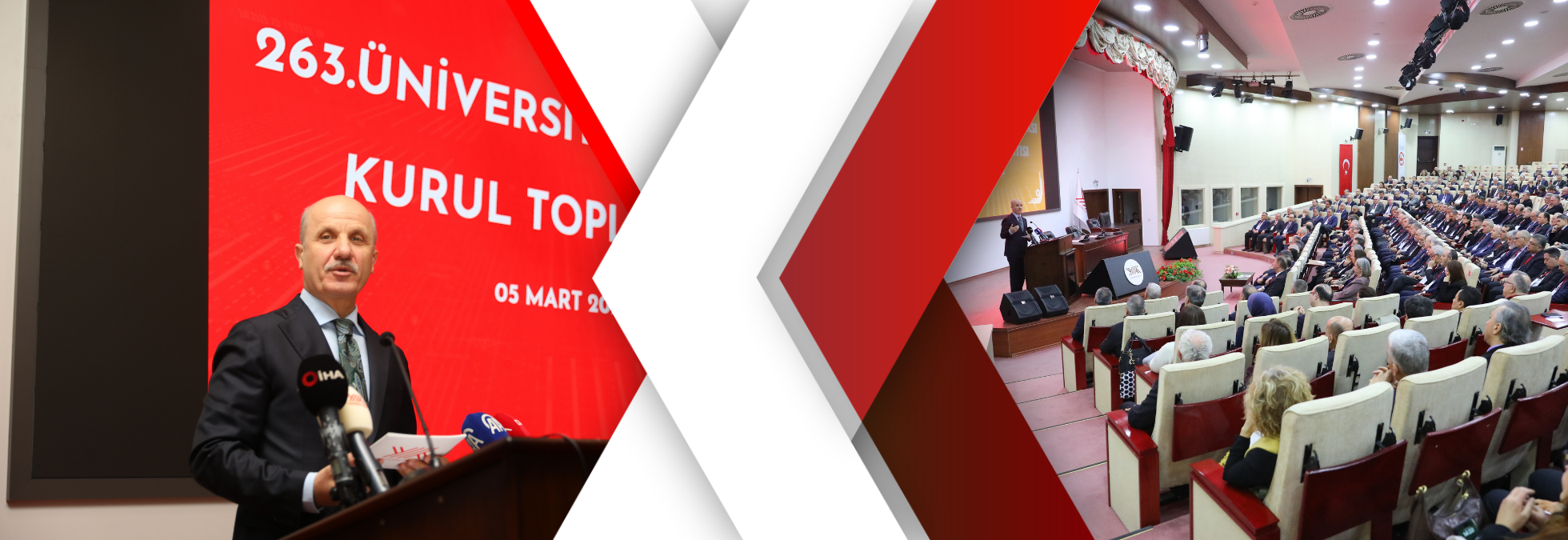
263rd Interuniversity Board Meeting Held at Council of Higher Education
Council of Higher Education President Özvar:
“We will take concrete steps to train faculty members for information technology–based programs.”
“We will administer a centralized exam and offer graduate education opportunities in IT-based programs. Subsequently, we will employ them in these programs at our universities.”
“The fact that OIZ–VS graduates have reached an employment rate of approximately 92 percent is extremely important as it demonstrates the strong success of the model.”
March 5, 2026
President of the Council of Higher Education Erol Özvar stated that concrete steps will be taken to train faculty members for recently introduced IT-based programs. “We have received approval for the required positions. We will administer a centralized exam for bachelor’s graduates from different fields and provide those who succeed with opportunities for graduate education in IT-based programs. Afterwards, we will employ them in the relevant programs at our universities,” he said.
The 263rd Interuniversity Board (UIB) Meeting was held under the chairmanship of Council of Higher Education President Özvar.
Speaking at the meeting held at the Council of Higher Education, Özvar noted that higher education is no longer merely a field where teaching and learning activities are carried out; rather, it has become a strategic arena where countries’ development capacity, the quality of human capital, production power, and international competitiveness are shaped.
- “Academic prestige cannot be defined solely by publication performance”
Özvar emphasized that universities’ academic prestige is no longer measured solely by publication capacity, but also by their ability to enhance graduates’ participation in employment and their contribution to the country’s economic development.
“Service to society is also one of the key pillars, just as important as these,” Özvar said. “In this regard, we will take these parameters into account in our future work on academic prestige.”
Stating that in recent years the system has been moving away from a quantity-driven growth model toward a transformation centered on quality, alignment with employment, and social impact, Özvar highlighted that a meticulous process is being followed in quota planning. “In this process, we evaluate our universities’ physical and academic capacities, our country’s employment structure, the pace of transformation in various sectors, labor market trends, and potential future professions within a comprehensive framework,” he said.
- “We are taking an important step to meet the need for qualified faculty in new programs”
Özvar stated that concrete steps will be taken to train faculty members for recently launched IT-based programs and shared the following information:
“In this regard, we have consulted with the Ministry of Treasury and Finance and the Presidency of Strategy and Budget and obtained approval for the necessary positions. We will administer a centralized exam for graduates from different disciplines and provide those who succeed with opportunities for graduate education in IT-based programs. Afterwards, we will employ them in the relevant programs at our universities. In this way, we will take an important step toward meeting the need for qualified faculty members required for these new programs.”
- “Workplace-based applied vocational education”
Özvar noted that global transformations—driven by digitalization, artificial intelligence, automation, green transformation, and sustainability-oriented policies—are making new skill sets essential in the labor market, and he emphasized that vocational schools stand at the center of this transformation.
Highlighting that workplace-based applied vocational education lies at the heart of this transformation, Özvar said, “Applied education already exists within our system. Our goal is to establish a certain standard, expand its scope, and institutionalize it in alignment with industry.”
Özvar added that vocational schools established within Organized Industrial Zones have built a structure where students can apply what they learn in the classroom on the production line, in workshops, or in the field on the same day, thereby significantly reducing the gap between education and the business world.
“The fact that OIZ–VS graduates have reached an employment rate of approximately 92 percent is extremely important as it demonstrates the strong success of the model,” Özvar said. “What makes the OIZ–VS approach valuable is not merely that it increases the duration of practical training, but that it fundamentally transforms the nature of learning.”