


Major Transformation in Lifelong Learning in Higher Education
- Following the introduction of micro-credentials, certificate programs are also entering a new era of common quality standards.
- From 1 October onward, all new certificate programs will require the approval of the Council of Higher Education, and certificates will be issued through the e-Government Gateway.
- President of the Council of Higher Education Erol Özvar: “We are bringing the certificate programs offered by our universities under a common framework of quality standards.”
July 6, 2026
The Council of Higher Education has taken another significant step in transforming higher education by extending its reform agenda beyond degree programs to encompass lifelong learning.
Following the recent introduction of the Micro-Credentials Framework, which enables knowledge, skills, and competencies acquired outside the university environment to be formally recognized within the higher education system, the Council is now introducing a centralized quality assurance process for certificate programs delivered by universities’ Continuing Education Centers.
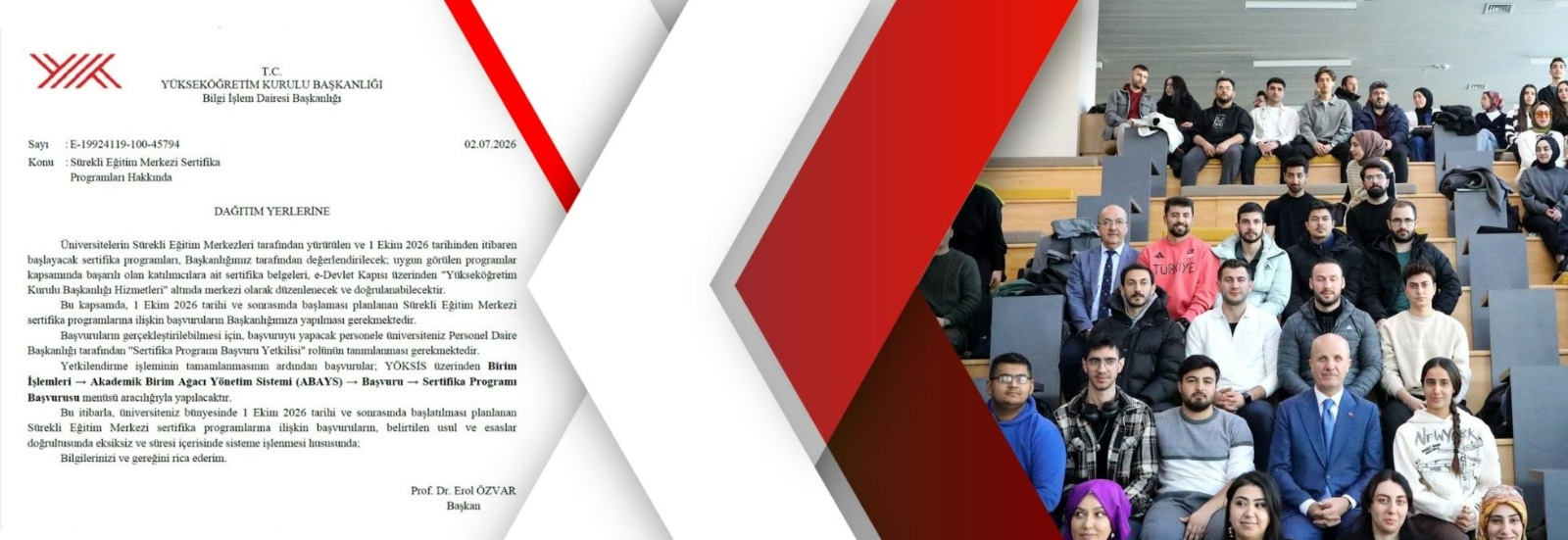
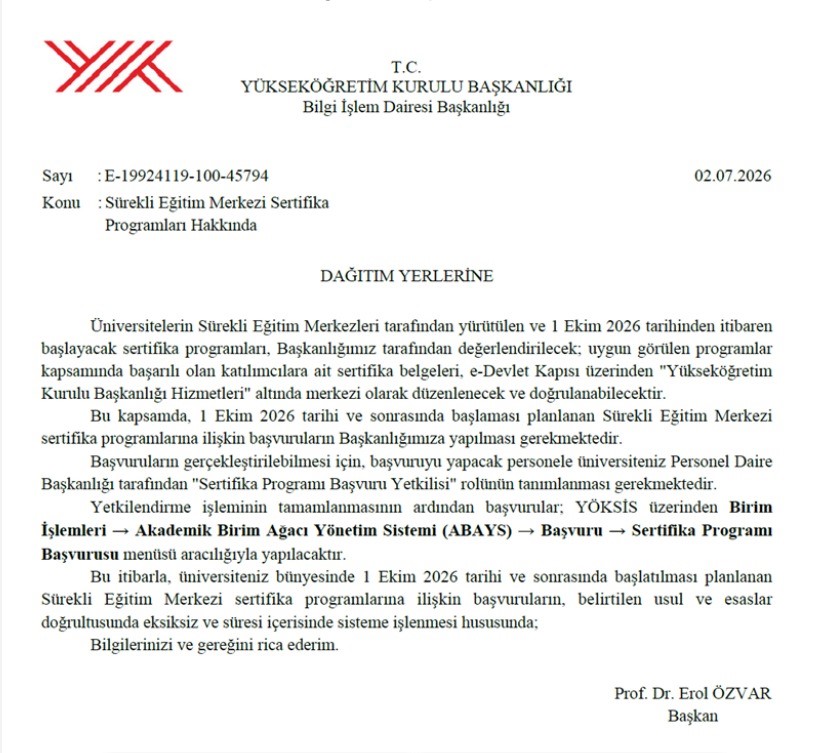
According to a circular sent by the Council of Higher Education to all universities on 2 July 2026, all certificate programs offered by Continuing Education Centers from 1 October 2026 onward will be subject to evaluation and approval by the Council of Higher Education.
For the first time, participants who successfully complete programs approved by the Council of Higher Education will receive certificates issued centrally by the Council through the e-Government Gateway (e-Devlet). These certificates will be digitally verifiable.
All applications will be submitted electronically through the Higher Education Information System (YÖKSİS).
- Strengthening quality assurance in lifelong learning
Through a series of recent reforms, the Council of Higher Education is transforming higher education into more than a system of formal degree-granting institutions by establishing a robust ecosystem that supports lifelong learning.
With the recently enacted Micro-Credentials Framework, knowledge and skills acquired outside universities can now be formally recognized within the academic system, enabling students to fulfill part of their graduation credit requirements through learning experiences completed beyond the university environment.
Now, by evaluating certificate programs offered through Continuing Education Centers according to common quality standards and integrating them into a centralized verification system, quality assurance in lifelong learning is being strengthened even further.
Certificate programs that meet the established quality criteria will also benefit from a strong infrastructure that allows them to be structured in line with the micro-credentials approach.
As a result, quality assurance across higher education will become more comprehensive by covering both degree programs and short-term educational programs delivered within the lifelong learning framework.
- High-quality education, trusted credentials
Under the new system, the content of certificate programs will be evaluated against common quality standards, creating a more standardized and reliable framework across universities.
Certificates will be issued centrally through the e-Government Gateway and will be digitally verifiable. Public institutions and employers will be able to authenticate certificates electronically, enhancing both the credibility of educational credentials and their international recognition.
- Özvar: “We are launching a new era of quality in lifelong learning”
President of the Council of Higher Education Erol Özvar emphasized that, in today’s knowledge society, learning is no longer confined to university education. He stated that the common objective of the higher education reforms implemented in recent years has been to ensure that individuals can acquire the knowledge and competencies they need throughout their lives within a robust quality assurance framework.
Highlighting that the reforms introduced—from micro-credentials to certificate programs—form a comprehensive structure that supports lifelong learning through quality assurance, Özvar said: “Our Continuing Education Centers are important educational institutions that respond to the evolving needs of society. We are bringing the certificate programs offered by our universities under a common framework of quality standards. Through this initiative, we are not only ensuring the quality of education but also providing citizens with certificates that are verifiable through the e-Government Gateway, reliable, and aligned with international standards.”
Recalling that the recently introduced Micro-Credentials Framework paved the way for the academic recognition of knowledge and skills acquired outside universities, Özvar added: “With the step we are taking today, we are completing another important component of our lifelong learning ecosystem. Certificate programs implemented under a quality assurance framework will gain a strong infrastructure that will enable them to be structured in line with the micro-credentials approach, provided they meet the established criteria. In this way, we are creating a stronger and more sustainable lifelong learning system within higher education while continuing to advance our vision of competency-based higher education.”
- Building the new vision for higher education step by step
The introduction of new academic programs in AI and future-oriented professions, the implementation of an applied and employment-focused education model, the Micro-Credentials Framework, the academic recognition of learning acquired outside universities, and now the introduction of centralized quality assurance for certificate programs together constitute the latest transformation initiatives undertaken by the Council of Higher Education.
Taken together, these reforms reflect the Council of Higher Education’s vision of transforming higher education into a system that extends beyond traditional degree programs—one that is built upon lifelong learning, competency development, and quality assurance.
Images


Images